

This research paper is part of Truth Clearly’s commitment to providing an authentic Islamic perspective on theology and history. We adhere to rigorous academic standards, relying exclusively on the Quran, authentic Prophetic traditions, and verified historical sources to provide clarity for the rational seeker.
For the skeptical philosopher, the modern scientist, or the seeker of truth, the intersection of Divine Foreknowledge and human agency presents a formidable intellectual challenge. The dilemma is often framed thus: “If an All-Knowing Creator knows every choice I will make before I am even born, am I truly free? And if I am not free, how can I be held accountable?” This question, which explores the Logic of Free Will in Islam, is not merely a theological debate; it is the foundation of moral responsibility and the very purpose of human existence.
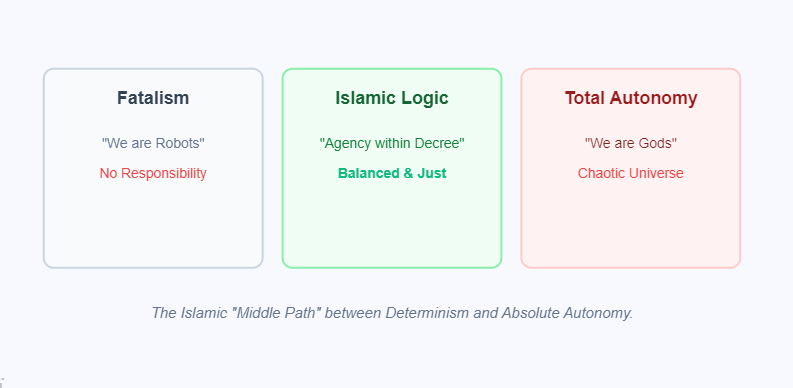
In many religious and secular philosophies, the answer tilts toward extremes—either total determinism (fatalism) or total, unchecked autonomy (existentialism). However, the Logic of Free Will in Islam offers a sophisticated “middle path” that reconciles the absolute sovereignty of the Creator with the genuine agency of the created. This article explores seven profound keys that unlock the logic of how human choice operates within a divinely decreed universe.
Table of Contents
1. Knowledge vs. Compulsion: The Teacher Analogy
The primary logical confusion in the debate over the Logic of Free Will in Islam is the conflation of “knowledge” with “cause.” Skeptics often argue that because God knows a future event, He must have compelled it to happen. However, in the realm of logic, knowledge of an outcome does not necessitate the coercion of that outcome.
To simplify this, consider a highly experienced teacher who has observed a student’s habits all year. The teacher knows with 99% certainty that this student will fail the final exam because they refuse to study. On the day of the result, the student fails. Did the teacher’s prior knowledge cause the student to fail? Of course not. The failure was the direct result of the student’s choices.
Allah’s knowledge encompasses everything—past, present, and future—from His position High above the Heavens, without forcing human choice. Divine knowledge is a record of our agency, not a cage for it. This understanding is crucial for the Concept of God in Islam as a Being whose omniscience does not infringe upon the dignity of human choice.
2. Human Agency: The Logic of Will and Power
Islam teaches that while Allah is the Creator of all that exists—including our actions—humans possess a real will and a real power to choose, for which they are held accountable. This is a central pillar of Divine Justice.
Logically, while Allah is the Ultimate Cause who created the laws of biology and physics, He granted humans the agency to initiate actions. When you decide to act, you are using the will and the physical power that Allah has placed within you. Allah is the Creator of the agent and his ability, but the human is the one who truly performs the act.
The Logic of Free Will in Islam argues that we are judged because we are the actual doers of our deeds. We are not forced “puppets,” nor are we independent “gods” creating our own existence. Instead, we operate within the capacity Allah gave us. This ensures that while Allah remains the Sovereign Creator of all, the moral responsibility rests squarely on the human agent who chose to exercise their will in a specific direction.
3. The Two Wills: Creative Will vs. Legislative Will
To navigate the Logic of Free Will in Islam, one must distinguish between two types of “Divine Will.” Misunderstanding these leads to the false conclusion that if God allowed an evil act to happen, He must “approve” of it.
- The Creative Will (Al-Iradah al-Kawniyyah): This refers to everything God allows to exist in the physical universe, including gravity, light, and the human ability to choose. If God did not “will” for you to have the ability to commit a sin, you wouldn’t be able to do it.
- The Legislative Will (Al-Iradah al-Shar’iyyah): This refers to what God “loves” and “commands.” God commands justice, honesty, and mercy.
The Logic of Free Will in Islam explains that God allows (Creative Will) what He may not necessarily approve of (Legislative Will) for the higher purpose of testing human agency. If God only allowed what He approved of, free will would vanish, and the world would be a place of programmed obedience rather than earned virtue. This is the same logic we explored in the Logic of Suffering in Islam, where the existence of a trial is a prerequisite for spiritual growth.
4. Divine Justice: The Necessity of Choice
If human life were a pre-determined movie where every “actor” had no choice, then the concept of “Judgment Day” would be the height of injustice. However, as we established in the discussion on Life After Death and Divine Justice, Islam is built on the unshakeable pillar of accountability.
Logically, accountability is only valid where there is a choice. A person who is pushed off a cliff is not responsible for their fall; but a person who jumps is. The Logic of Free Will in Islam asserts that God, being the Most Just, would never punish a soul for an action it had no power to avoid. The very existence of “Commandments” and “Prohibitions” in the Quran serves as a logical proof that humans possess the capacity to obey or disobey. Divine Law is only meaningful when addressed to a free agent.
5. The Limit of Determinism: Biology vs. Morality
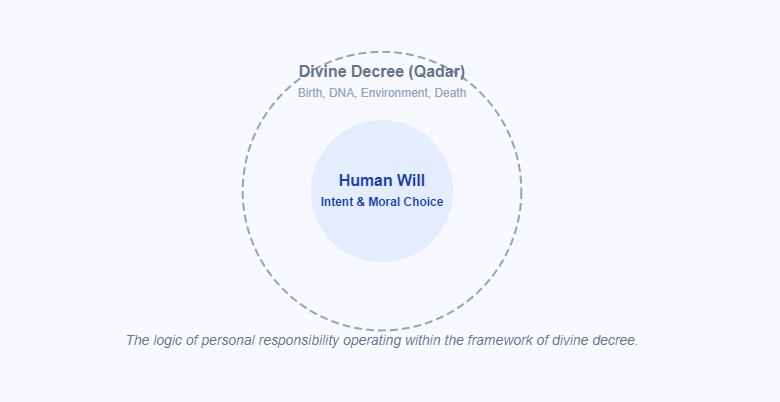
Modern neuroscience and psychology often lean toward determinism, suggesting that our genes and environment dictate our behavior. The Logic of Free Will in Islam acknowledges that we are indeed “determined” in our “circumstances,” but “free” in our “response.”
You did not choose your parents, your DNA, or the era in which you were born. These are part of Qadar (Divine Decree). However, the Logic of Free Will in Islam focuses on the “Moral Choice” within those parameters. God does not judge a blind man for not reading the Quran, nor a poor man for not giving millions in charity. Judgment is scaled to the specific “radius of freedom” granted to each individual. This nuanced view of Islam and Human Rights ensures that every human is treated according to their unique capacity and intent.
6. Prayer and the Changing of Decree
A frequent skeptical question regarding the Logic of Free Will in Islam is: “If everything is written, why pray?” This is answered by the profound reality that “Prayer” (Dua) is itself part of the decree.
In Islamic logic, God may decree that a specific blessing will reach a person only if they ask for it. The act of asking is the “cause,” and the blessing is the “effect”—both are known to God, but the human must initiate the cause. This creates a dynamic relationship between the Creator and the created, where human initiative is a recognized force within the cosmic order. It is a logical system where the “effort” of the believer is a variable that God accounts for in the unfolding of history.
7. The Psychological Balance: Between Hope and Fear
Finally, the Logic of Free Will in Islam serves a vital psychological function. Belief in Qadar (Decree) provides a Muslim with “unshakeable peace,” while belief in Free Will provides “unshakeable responsibility.”
- When a calamity happens: The believer says, “It was decreed,” which prevents depression and the “if only” cycle of regret.
- When a choice is presented: The believer knows, “I am responsible,” which prevents laziness and fatalism.
This balance is a hallmark of the Sincerity of Prophet Muhammad, who worked harder than any man while maintaining the highest level of trust in God’s plan. For the skeptical reader, this framework offers a pragmatic solution to the “existential dread” of a random universe or the “stagnation” of a determined one.
Conclusion: The Grand Architecture of Choice
The Logic of Free Will in Islam reveals a universe that is neither a chaotic accident nor a rigid machine. It is a grand architecture designed for a specific purpose: the development of moral character through choice. By acknowledging that Divine Knowledge encompasses but does not negate human agency, Islam provides a worldview that is both intellectually satisfying and morally demanding.
Just as the Authenticity of the Quran is supported by its internal consistency, the Islamic view of human agency is supported by its alignment with the human experience of choice and the demand for justice. In the end, the Logic of Free Will in Islam invites us to recognize that we are not robots, nor are we gods. We are servants gifted with the most precious of divine qualities: the freedom to choose our own path toward the Truth.










Leave a Reply