
This research paper is part of Truth Clearly’s commitment to providing an authentic Islamic perspective on theology and history. We adhere to rigorous academic standards, relying exclusively on the Quran, authentic Prophetic traditions, and verified historical sources to provide clarity for the rational seeker.
When exploring the religious history of late antiquity and the theological bridges connecting the Abrahamic faiths, few figures are as pivotal—and as differently interpreted—as Jesus of Nazareth. To the skeptical Western reader, whether Christian, agnostic, or a student of history, the prevailing narratives of Jesus are often binary: he is either the incarnate Son of God of orthodox Christian theology or the apocalyptic Jewish preacher reconstructed by secular historians. However, a third, deeply profound paradigm exists. Jesus in Islam is a figure of immense veneration, understood not through the lens of incarnation, but through a strict, logical monotheism and a continuous historical chain of prophethood.
In Islamic theology, Prophet Isa (the Arabic name for Jesus) is revered as the Messiah, a worker of miracles, and one of the greatest messengers of God. Yet, the Islamic view on Jesus consciously departs from Christian orthodoxies established at the Councils of Nicaea and Chalcedon. By examining the Quranic text alongside historical context and rational theology, we can understand how Islam constructs an internally consistent, logically framed Christology that honors Jesus while fiercely preserving the indivisible oneness of God.
This article invites you to a logical and academic investigation into Jesus in Islam, exploring seven key facts that define his role in the final revelation.
Table of Contents
1. Jesus in Islam: The Quranic Context
To understand the Islamic view on Jesus, one must first position him within the literary and theological landscape of the Quran. Revealed in the 7th century CE, the Quran addressed an Arabian Peninsula that was a crossroads of various religious traditions, including Judaism, various Christian sects, and indigenous polytheism.
From a comparative theological perspective, Islam views history as a single, unfolding narrative of divine revelation. God does not change His core message, nor does He alter His fundamental nature. Prophets—from Adam to Noah, Abraham, Moses, Jesus, and finally Muhammad—were all sent with the identical core message: Tawhid, or absolute monotheism.
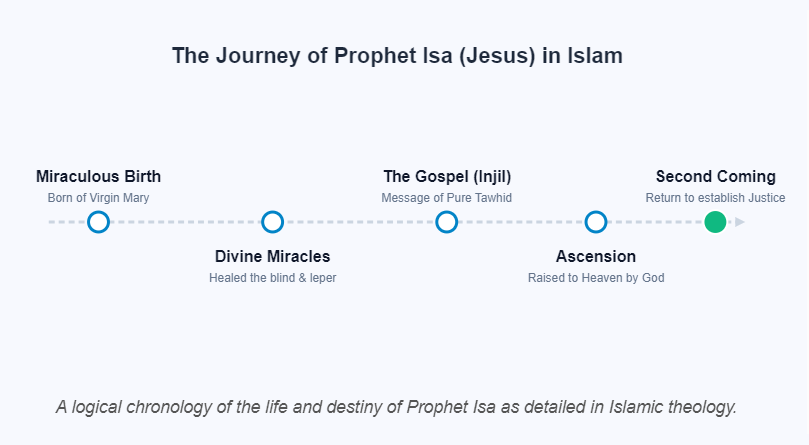
Jesus in Islam is placed near the apex of this prophetic chain. He is mentioned by name 25 times in the Quran—more times than the Prophet Muhammad himself. Furthermore, he is granted exalted titles unparalleled by other prophets. He is called Al-Masih (The Messiah), Kalimatullah (The Word of God), and Ruhun min’Allah (A Spirit from God). This veneration is a key pillar of the Sincerity of Prophet Muhammad, who taught his followers to love and respect Jesus as a biological and spiritual brother.
2. The Miraculous Birth: A Logic of Omnipotence
The virgin birth of Jesus is a dogma shared by both Christianity and Islam, presenting a fascinating point of convergence. However, while traditional Christian theology uses the virgin birth as evidence of Jesus’s divine sonship, the framework of Jesus in Islam applies a different logical conclusion to the same miraculous premise.
Chapter 19 of the Quran is named Surah Maryam (Mary), an homage to the mother of Prophet Isa. Mary is the only woman mentioned by name in the entire Quran, and she is elevated above all women in creation. The Quranic narrative details the Annunciation, where angels inform Mary that God has chosen her to bear a son despite her chastity.
When Mary questions how this can be, the Quran provides a logically consistent answer grounded in omnipotence: “He said, ‘Thus [it will be]; your Lord says, ‘It is easy for Me… And when He decrees a matter, He only says to it, ‘Be,’ and it is.’” (Quran 19:21). To a skeptical mind, a virgin birth defies the laws of biology, but in Islamic philosophy, miracles are understood as temporary suspensions of habitual physical laws by the Lawgiver Himself.
The Quran counters the logical leap from “miraculous birth” to “divine sonship” with a powerful comparison:
“Indeed, the example of Jesus to Allah is like that of Adam. He created Him from dust; then He said to him, ‘Be,’ and he was.” (Quran 3:59).
If being born without a human father necessitates divinity, then Adam—who was created without a father or a mother—would possess a greater claim to divinity than Jesus. This reasoning is a cornerstone for understanding the Authenticity of the Quran (read more here) as a corrective text.
3. The Status of Jesus vs. Son of God: An Ontological Analysis
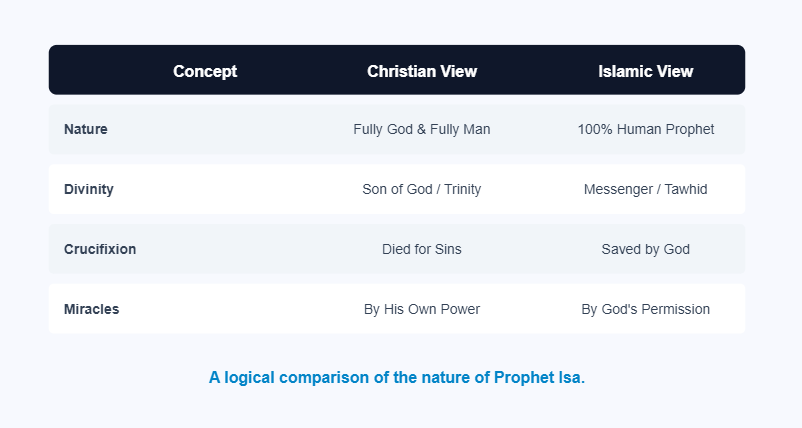
The most significant theological divergence between Christianity and Islam lies in the ontology of Jesus. The Islamic view on Jesus firmly rejects the concepts of the Trinity, the Incarnation, and the title “Son of God.” For the Western skeptic evaluating comparative religion, the Islamic argument rests heavily on philosophical logic and the preservation of divine transcendence.
The Islamic view on Jesus firmly rejects the concepts of the Trinity, the Incarnation, and the title “Son of God.” This rejection is rooted in the absolute distinction between the Creator and the created. In Islamic theology, Allah possesses attributes of absolute perfection and is As-Samad (The Self-Sufficient), while all of creation is inherently dependent and deficient.
Allah, the Most High, is established over His Throne, distinct from His creation, and “Nothing is like unto Him.” To suggest that God became a man is a logical and scriptural contradiction to His Divine Majesty. A human being is subject to hunger, sleep, and mortality—attributes that can never be attributed to the Creator. Therefore, Jesus in Islam is recognized as a majestic and honored messenger, but a mortal human servant of Allah nonetheless.
Islam replaces the mystery of the Trinity with the stark clarity of Tawhid (Absolute Monotheism). The Quran addresses the People of the Book, urging them to return to the pure worship of the Creator alone:
“O People of the Scripture, do not commit excess in your religion… The Messiah, Jesus, the son of Mary, was but a messenger of Allah… So believe in Allah and His messengers. And do not say, ‘Three’; desist – it is better for you.” (Quran 4:171).
4. Miracles as Divine Proofs, Not Divine Essence
Throughout the Quran, Jesus in Islam is depicted performing extraordinary miracles. He speaks from the cradle to defend his mother’s honor, heals the blind and the leper, and even breathes life into birds made of clay. However, there is a crucial logical caveat repeated after every miracle: they were performed “by God’s permission” (Bi-idhnillah).
This distinction is vital. In the Islamic paradigm, a miracle is not proof of the performer’s divinity, but proof of the Sender’s power. Just as Moses divided the sea by God’s permission, Prophet Isa performed his miracles to validate his message to the Children of Israel. This aligns with the scientific logic found in the Quran, where laws of nature are subservient to the Creator.
5. The Message of Prophet Isa: Fulfillment of the Law
Jesus in Islam was not sent to start a new religion, but to confirm and reform the existing Abrahamic tradition. His mission was twofold: to correct the rigid, legalistic deviations of the Israelites and to prophesy the coming of the final messenger.
Islam confirms that Jesus was given a divine revelation called the Injil (Gospel). Historically, this differs from the four New Testament Gospels, which are biographical accounts. The Islamic view holds that the original Injil was a direct revelation to Jesus, emphasizing mercy and spiritual depth. This concept is explored further in the study of Muhammad in the Bible, where Jesus promises the arrival of the Paraclete (Ahmad).
6. The Crucifixion: A Historical and Theological Divergence
No exploration of Jesus in Islam is complete without addressing the crucifixion. It is here that history, orthodox Christianity, and Islamic theology clash most dramatically. Islam rejects the concept of original sin and “atoning sacrifice.” In Islamic logic, every human being is responsible solely for their own actions.
Consequently, the Quranic narrative diverges:
“And they did not kill him, nor did they crucify him; but [another] was made to resemble him to them… Rather, Allah raised him to Himself.” (Quran 4:157-158).
To a secular historian, this claim mirrors early Gnostic traditions (such as Docetism) which also held that Jesus did not physically die on the cross. The Islamic reasoning is rooted in divine justice: God would not allow His ultimate Messiah to be humiliated and murdered by his oppressors. This “rescue” of Prophet Isa is seen as the final miracle of his earthly ministry.
7. The Second Coming: Jesus as a Sign of the Hour
Islamic eschatology grants Jesus in Islam a role that no other prophet shares: he is the only prophet who will return to Earth before the Day of Judgment.
However, his return is not as a new law-bringer or a deity. He will return as a follower of the final revelation (the Quran) to defeat the false messiah (Al-Masih ad-Dajjal) and establish a period of universal peace and justice. This belief reinforces the Islamic concept of the Afterlife and Divine Justice, where all historical accounts are eventually settled.
Conclusion: Reclaiming the Historical Prophet Isa
Understanding Jesus in Islam requires the reader to step outside the familiar dichotomy of “Divine Savior” versus “Historical Preacher.” The Islamic view on Jesus presents a rigorous, logically cohesive paradigm. By stripping away Hellenistic philosophical layers, Islam seeks to restore Prophet Isa to his original context: a majestic, mortal messenger of the One True God.
Whether approached from faith or skepticism, the Quranic Christology is undeniably profound. It respects the miraculous elements of Jesus’s life while using rational philosophy to maintain an unbridgeable gap between the Creator and the created. In exploring the figure of Jesus in Islam, we uncover a bridge that connects the hearts of billions, rooted in the shared heritage of the 5 Pillars of Faith.









Leave a Reply