
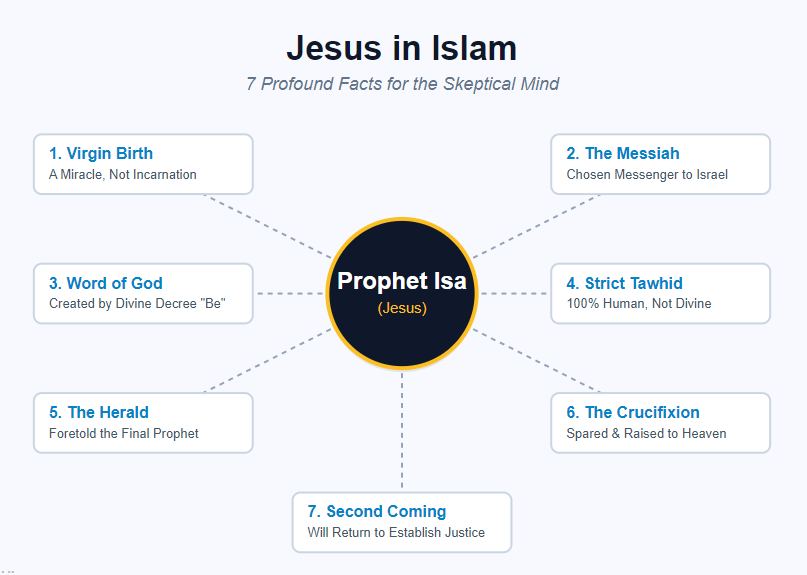
When exploring the religious history of late antiquity, the concept of Jesus in Islam stands out as one of the most fascinating theological bridges connecting the Abrahamic faiths. To the skeptical Western reader, whether Christian, agnostic, or a student of history, the prevailing narratives of Jesus are often binary: he is either the incarnate Son of God of orthodox Christian theology or the apocalyptic Jewish preacher reconstructed by secular historians.
However, a third, deeply profound paradigm exists. Jesus in Islam (known as Prophet Isa) is a figure of immense veneration, understood not through the lens of incarnation, but through a strict, logical monotheism and a continuous historical chain of prophethood. This article explores the Islamic view on Jesus through academic reasoning and historical context.
Table of Contents
1. The Centrality of Jesus in Islam
To understand Jesus in Islam, one must first position him within the literary and theological landscape of the Quran. Revealed in the 7th century CE, the Quran addressed an Arabian Peninsula that was a crossroads of various religious traditions.
From a comparative theological perspective, Islam views history as a single, unfolding narrative of divine revelation. Prophets—from Adam to Noah, Abraham, Moses, and finally Muhammad—were all sent with the identical core message: Tawhid, or absolute monotheism.
Prophet Isa is placed near the apex of this prophetic chain. In fact, exploring Jesus in Islam reveals that he is mentioned by name 25 times in the Quran—more times than the Prophet Muhammad himself. He is granted exalted titles such as Al-Masih (The Messiah) and Ruhun min’Allah (A Spirit from God).
2. Recontextualizing the “Word of God”
For the Western reader accustomed to the Gospel of John, the title “Word of God” (Logos) immediately implies divinity. However, the framework of Jesus in Islam redefines this logically.
In Islamic theology, Jesus is the “Word” because he came into existence through God’s direct command—”Be” (Kun)—rather than through standard biological reproduction. He is the physical manifestation of God’s creative decree. This distinction highlights how the Islamic view on Jesus utilizes familiar Judeo-Christian terminology but recalibrates it to maintain a strict boundary between the Creator and the created, a concept heavily debated during the Councils of Nicaea and Chalcedon.
3. The Logic of the Miraculous Birth
The virgin birth of Jesus is a dogma shared by both Christianity and Islam. Yet, while traditional Christian theology uses the virgin birth as evidence of divine sonship, the narrative of Jesus in Islam applies a different logical conclusion.
Chapter 19 of the Quran is named Surah Maryam (Mary). The Quranic narrative details the Annunciation, where angels inform Mary that God has chosen her to bear a son. When she questions this, the Quran provides a logically consistent answer grounded in omnipotence: “He said, ‘Thus [it will be]; your Lord says, ‘It is easy for Me…’” (Quran 19:21).
To a skeptical mind evaluating Jesus in Islam, Islamic philosophy (Kalam) argues that miracles do not necessitate divinity. The Quran counters the Christian leap from “miraculous birth” to “divinity” with a powerful comparative argument:
“Indeed, the example of Jesus to Allah is like that of Adam. He created Him from dust; then He said to him, ‘Be,’ and he was.” (Quran 3:59).
If being born without a human father makes one divine, then Adam—created without a father or a mother—would possess a greater claim to divinity. This is a foundational pillar when studying Jesus in Islam.
4. Jesus in Islam vs. The Son of God Concept
The most significant theological divergence lies in ontology. The doctrine of Jesus in Islam firmly rejects the Trinity and the Incarnation.
To the Islamic theological mind, the hypostatic union (fully God and fully man) presents an insurmountable logical contradiction. The attributes of the Creator (infinite, eternal) and the creation (finite, temporal) are mutually exclusive. The Infinite cannot become finite without ceasing to be infinite. Therefore, Jesus in Islam categorizes the deification of Prophet Isa as a historical tragedy influenced by Greco-Roman pagan concepts.
Islam replaces the mystery of the Trinity with clarity. By insisting on his humanity, Jesus in Islam does not seek to demote him, but rather to elevate God to His rightful, transcendent place. If you are interested in how this applies to daily worship, read our guide on the five pillars of Islamic faith.
(Placeholder: Embed a relevant YouTube video here to satisfy the Rich Media/Video SEO requirement)
5. Prophecies Fulfilled: The Paraclete
In the Islamic worldview, Jesus was not an isolated phenomenon. His mission was twofold: to correct the rigid deviations of his time, and to prophesy the coming of the final messenger.
A crucial element of Jesus in Islam is his role as a herald. The Quran explicitly states that Jesus brought “good tidings of a messenger to come after me, whose name is Ahmad” (Quran 61:6).
Muslim scholars historically cross-reference this with the Gospel of John, specifically Jesus’s promise of the coming Parakletos (Advocate). While orthodox theology identifies this as the Holy Spirit, Islamic scholars point out that the Greek text describes a human-like figure who “will not speak on his own; he will speak only what he hears.” To the skeptical reader, this presents a fascinating study in comparative religious exegesis (External DoFollow Link), demonstrating how the narrative of Jesus in Islam intersects with biblical texts.
6. The Crucifixion: A Divergent History
No exploration of Jesus in Islam is complete without addressing the crucifixion. It is here that history, orthodox Christianity, and Islamic theology clash most dramatically.
Islam rejects the concept of original sin entirely. Thus, a blood sacrifice to appease God’s justice is deemed philosophically unnecessary. Consequently, the historical narrative of Jesus in Islam diverges:
“And they did not kill him, nor did they crucify him; but [another] was made to resemble him to them… Rather, Allah raised him to Himself.” (Quran 4:157-158).
To a secular historian, this seems radically disconnected from first-century accounts. However, experts in religious history recognize that the concept of Jesus in Islam regarding the crucifixion mirrors early Christian and Gnostic traditions (like Docetism), which also believed Jesus did not physically die on the cross. The Islamic reasoning is rooted in divine justice: God would not allow His ultimate Messiah to be humiliated and murdered by his oppressors.
7. The Second Coming of Prophet Isa
Finally, eschatology plays a massive role in the concept of Jesus in Islam. Islamic tradition asserts that Jesus will return in the end times. However, he will not return as a new prophet or a god, but as a righteous leader and a follower of the final revelation, sent to defeat the false messiah (Al-Masih ad-Dajjal) and establish justice on earth.
Conclusion
Understanding Jesus in Islam requires the Western reader to step outside the familiar dichotomy of “Divine Savior” versus “Historical Preacher.” The Islamic view on Jesus presents a rigorous, logically cohesive paradigm. By stripping away the layers of Hellenistic philosophy, Islam seeks to restore Prophet Isa to his original, historical context: a majestic, miracle-working, mortal messenger of the One True God.
Whether one approaches this from the perspective of a believer or a skeptical academic, the Christology of Jesus in Islam is undeniably profound. It respects the miraculous elements of Jesus’s life while using rational philosophy to maintain an unbridgeable gap between the Creator and the created.
Leave a Reply