

Truth Clearly is committed to fostering mutual understanding among Abrahamic faiths. This article examines the historical and scriptural attributes of Prophet Jesus (peace be upon him) from an Islamic viewpoint, focusing on the logical distinctions between the Creator and the messenger.
One of the most defining attributes of the Divine is absolute omniscience—the total, unshared knowledge of all that was, is, and will be. For the skeptical Western seeker or the student of theology, the claim that Jesus of Nazareth is God must be reconciled with his recorded limitations. The most striking of these is found in the discussion of Jesus and the Day of Judgment. In a clear and unambiguous passage, Jesus explicitly denies having knowledge of the “Hour” (the end of the world), stating that this knowledge belongs solely to the Father.
In the Islamic worldview, specifically the Sunni Athari perspective, we recognize Allah as the All-Knowing Creator who is High above His Heavens and established over His Throne. Allah possesses the keys to the Unseen, and no creature—not even the highest angel or the greatest prophet—shares in His absolute Knowledge. Jesus in Islam is revered as a mighty messenger, but his admitted lack of knowledge regarding the end times is a powerful logical credential of his humanity. This article explores seven profound logical proofs regarding Jesus and the Day of Judgment, demonstrating why the lack of omniscience is the definitive evidence against his divinity.
Table of Contents
1. The Explicit Denial of Omniscience
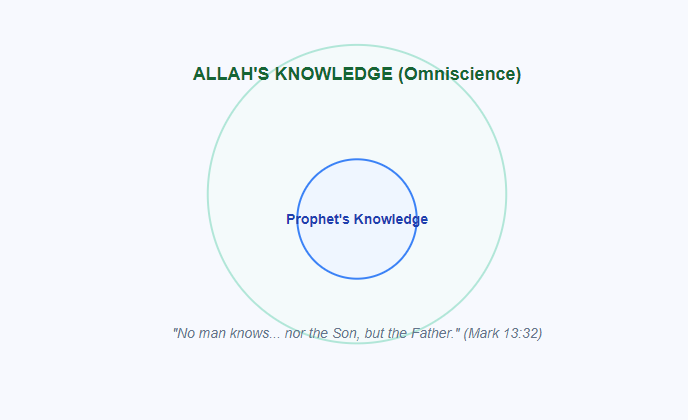
The primary logical pillar in the study of Jesus and the Day of Judgment is the text of Mark 13:32. When asked about the end times, Jesus replied:
“But of that day and that hour knoweth no man, no, not the angels which are in heaven, neither the Son, but the Father.” (Mark 13:32, KJV).
Logically, if Jesus were God, he would be the Father, or at least share the Father’s essence. An essential part of the “God-essence” is knowing everything. To say “the Son does not know” creates an ontological separation between Jesus and the Creator. This aligns with the Concept of God in Islam where Allah is the only One who knows the future. The Authenticity of the Quran clarifies that even Muhammad (peace be upon him) was commanded to say: “I do not know what will be done with me or with you” (Quran 46:9).
2. The Logic of Essence: Knowledge as a Non-Transferable Attribute
In the framework of Jesus and the Day of Judgment, we must analyze whether divinity can be “turned off.” Some apologists suggest Jesus “chose” not to know while on earth. Logically, this is an ontological contradiction.
An attribute of essence—like omniscience or self-sufficiency—cannot be suspended without the being ceasing to be God. If a being is “God” in one moment and “not All-Knowing” in the next, that being is subject to change. The Sunni tradition affirms that Allah is Eternal and Unchanging. Therefore, the admitted ignorance of Jesus and the Day of Judgment proves he was a dependent creature. This dependency is a hallmark of Islam and Human Logic.
3. Jesus and the Day of Judgment: The Role of a Servant
If we look at the mission of Jesus, his lack of knowledge regarding the Hour makes perfect sense within the Concept of Prophethood. A messenger is only responsible for delivering what he has been told.
Logically, a prophet is a human conduit for divine truth. He performs Miracles of Jesus in Islam by God’s permission, but he does not possess God’s infinite sight. Jesus’s admission that he did not know the Hour proves his Sincerity as a messenger who refused to claim for himself what belonged only to Allah. This honesty is why Islam considers him one of the five greatest prophets.
4. The Signs vs. The Event: Logical Distinction
While Jesus did not know the “Hour,” he was given knowledge of the Signs of the Day of Judgment in Islam. He warned his followers of tribulations and social shifts.
Logically, there is a difference between knowing the “Symptoms” and knowing the “Scheduled Time.” By providing signs but denying the time, Jesus acted exactly like all other prophets, including Muhammad as a Leader. This consistency proves that Jesus and the Day of Judgment was a topic used to anchor humanity in a state of constant preparedness and Worship in Islam, rather than satisfying a deity’s curiosity.
5. The Trinitarian Paradox: One Essence, Two Knowledges?
The Jesus and the Day of Judgment dilemma presents a fatal blow to the doctrine of the Trinity. If the Father, Son, and Holy Spirit are “One God,” they must logically possess one Mind and one Knowledge.
If the Father knows the Hour but the Son does not, they cannot be one being. To claim they have “different roles” does not solve the problem of “different knowledges.” The Concept of God in Islam as Al-Wahid (The One) is the only logical framework that avoids this paradox. It asserts that Allah is One, and His Knowledge is absolute and shared by none. This provides the rational seeker with the Why Islam answer: a religion without logical contradictions.
6. Historical Context: Refuting Hellenistic Deification
The scholarly inquiry into Jesus and the Day of Judgment reveals that early followers understood his limitations. It was only later, through the influence of Greek philosophy, that the idea of a “God-man” emerged.
Logically, if Jesus were God, the early Church would not have recorded his admission of ignorance in the Gospels, as it weakens the case for his divinity. The fact that this verse remains in the Bible is a historical “Fingerprint of Truth” that proves Jesus was indeed a man. Islam’s Preservation of the Bible and Quran dialogue highlights how these primitive truths survived even after the theological shift.
7. The Ultimate Return: Jesus as a Witness of the Hour
The final reality of Jesus and the Day of Judgment is his future role. Islam teaches that Jesus will return to earth as a sign of the approaching Hour.
Logically, his return is the ultimate correction. He will come to clarify that he was never a god and that he, too, is a servant awaiting the Life After Death and Divine Justice. By appearing at the end of time, Jesus becomes the physical evidence for Muhammad in the Bible prophecies, confirming that the message of the prophets was always one unified truth.
Conclusion: Reclaiming the Human Messiah
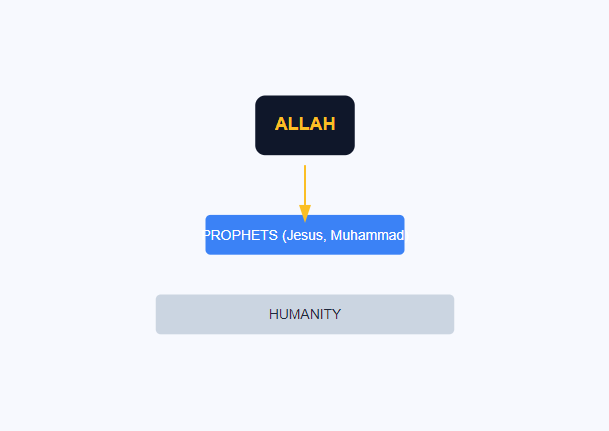
The investigation into Jesus and the Day of Judgment leads to a profound rational verdict: a being who does not know the future cannot be the Author of the future. By admitting his ignorance of the Hour, Jesus provided his followers with the ultimate proof of his mortal, prophetic status.
For the skeptical researcher, this admission is an invitation to look at the Authenticity of the Quran for the final, unclouded truth. Islam restores the dignity of Jesus by removing the impossible burden of divinity and placing him in his rightful place as a majestic messenger of Allah, the Most High, who alone knows the secrets of the heavens and the earth.














Leave a Reply