

This research paper is part of Truth Clearly’s commitment to providing an authentic Islamic perspective on theology and history. We adhere to rigorous academic standards, relying exclusively on the Quran, authentic Prophetic traditions, and verified historical sources to provide clarity for the rational seeker.
In the 21st century, humanity faces an unprecedented ecological crisis. From climate change to the loss of biodiversity, the skeptical Western reader or the modern scientist often looks toward philosophy or secular ethics for solutions. However, a rigorous logical and scriptural inquiry into Islamic Environmental Ethics reveals a sophisticated, divinely mandated system of “Stewardship” (Khilafah) that was established over fourteen centuries ago.
Islamic environmentalism is not a modern “green” reaction; it is a fundamental requirement of the Sunni Athari worldview. We believe in Allah—the Most High, who is established over His Throne and is distinct from His creation. He is the Creator of the Heavens and the Earth, and He has placed humanity on this planet not as owners, but as trustees (Khulafa). This article explores seven profound realities of Islamic Environmental Ethics, demonstrating how the authentic teachings of Prophet Muhammad (peace be upon him) provide a logical and sustainable framework for the preservation of our world.
Table of Contents
1. The Logic of Stewardship: Man as a Trustee (Khalifa)
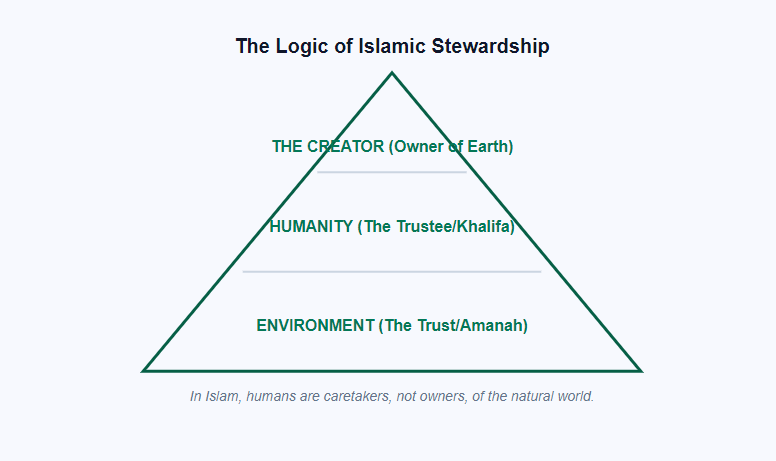
The primary logical pillar of Islamic Environmental Ethics is the concept of Khilafah. In Islamic theology, the earth and everything in it belong to Allah, the Sovereign Lord. Humanity has been granted a temporary “trust” (Amanah) to utilize these resources for a purposeful existence.
Logically, a trustee is not free to destroy what they do not own. A trustee must manage the estate according to the will of the Owner. Allah, the All-Wise (Al-Hakim), has established a “Mizan” (Balance) in the universe, as noted in the Scientific Realities of the Quran. To disrupt this balance is not just an ecological error; it is a moral violation of the trust. This foundation ensures that human development remains in harmony with the naturorld, a principle essential to Islam and Human Rights.
2. Purity of the Earth: The World as a Place of Worship
One of the most profound realities of Islamic Environmental Ethics is the spiritual status granted to the earth itself. Prophet Muhammad (peace be upon him) stated in a highly authentic report: “The earth has been made for me a place of worship (mosque) and a means of purification.” (Sahih Bukhari).
Logically, if the entire planet is a “mosque,” then pollution, degradation, and environmental destruction are acts of desecration. This prophetic directive transformed the relationship between the believer and the soil. It mandates that a Muslim must maintain the purity of the land as they would maintain the purity of their prayer rug. This perspective provides a powerful logical barrier against industrial practices that prioritize profit over the sanctity of the environment.
3. Water Management: The Logic of Scarcity and Gratitude
In an era of global water shortages, the Islamic Environmental Ethics regarding water conservation are strikingly relevant. Despite living in an arid desert environment, the Prophet established a strict protocol against the waste of water. He once passed by a companion performing ritual ablution and noticed he was using too much water. He told him: “Do not waste water, even if you were at the banks of a flowing river.” (Sahih – Ibn Majah/Ahmad).
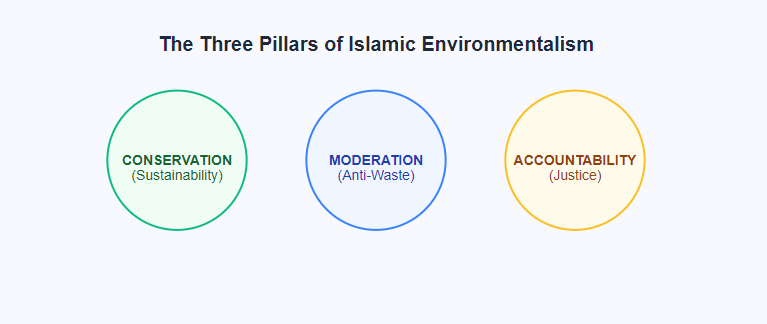
From a logical and economic standpoint, this “Prophetic Protocol” instills a mindset of conservation regardless of perceived abundance. It teaches that resources are a gift from Allah, the Most High, and wasting them is a form of ingratitude (Kufr al-Ni’mah). This aligns with the Five Pillars of Islamic Faith, where the act of purification (Wudu) is inseparable from the ethic of moderation.
4. Sustainable Planting: The Logic of Eternal Benefit
The Islamic Environmental Ethics encourage long-term ecological investment. The Prophet Muhammad (peace be upon him) delivered a powerful logical paradox regarding the end of the world: “If the Hour (Day of Judgment) is about to be established and one of you has a small plant (seedling) in his hand, then if he can plant it before the Hour happens, he should do so.” (Sahih – Musnad Ahmad).
This authentic Hadith teaches the logic of “Action over Despair.” Even when the result seems futile in a worldly sense, the act of planting—contributing to life—is a spiritual victory. It establishes a culture of “Perpetual Sustainability” where a believer plants trees from which they may never eat, knowing that their reward is with Allah, who is established over the Throne. This spirit of building for the future is what fueled the Islamic Civilization’s Contributions to Science.
5. Animal Welfare: Accountability for the Non-Human Soul
Islamic Environmental Ethics extend rights to animals, viewing them as “communities” like humans (Quran 6:38). Authentic Prophetic traditions provide specific legal protections for animals. The Prophet (peace be upon him) cursed those who used living creatures as targets and reprimanded a man for overloading his camel beyond its capacity.
Logically, if a human can be held accountable—and even enter the fire—for the mistreatment of a cat (as mentioned in a Sahih Bukhari report), then the welfare of animals is a core component of Divine Justice. This provides a robust ethical framework for modern debates on factory farming and animal testing. In the Logic of Free Will, our treatment of the vulnerable—including animals—is a primary metric of our moral success.
6. The Prohibition of Israf: The Logic Against Consumerism
The root cause of modern environmental collapse is “Israf” (excessive consumption and waste). The Quranic mandate is clear: “And eat and drink, but be not excessive. Indeed, He likes not those who commit excess.” (Quran 7:31).
In Islamic Environmental Ethics, consumption is balanced by “Haja” (need). Logically, a society that limits its desires to its needs will never face the crisis of overproduction and waste. The Prophet Muhammad (peace be upon him) lived a life of extreme simplicity, as explored in the Sincerity of Prophet Muhammad, proving that high spiritual and intellectual achievement does not require a large “carbon footprint.” This logic of moderation is the ultimate cure for the materialist culture of the modern West.
7. The Restoration of Land: The Logic of “Mawat”
Islam established a legal system to encourage the “greening” of the earth. The Prophet (peace be upon him) stated: “Whoever brings life to a dead land (Mawat), it belongs to him.” (Sahih – Tirmidhi/Abu Dawud).
This logical legal incentive encouraged individuals to reclaim barren land, plant gardens, and establish agriculture. It moved the responsibility of environmental restoration from a central government to the hands of every individual citizen. By linking property rights to environmental care, Islamic Environmental Ethics provided a practical solution for urban expansion and food security that is still studied by international environmental historians.
Conclusion: The Holistic Balance
The study of Islamic Environmental Ethics leads to a clear rational verdict: the preservation of the earth is not a choice, but a divine mandate. By recognizing the role of the Trustee (Khalifa), maintaining the purity of the “Earth-Mosque,” and rejecting the logic of excess, Islam provides a comprehensive blueprint for a sustainable future.
For the skeptical seeker, the environmental wisdom of Islam serves as another “Sign” of the divine origin of the Prophet’s message. It is a worldview where the health of the planet is tied to the health of the soul. As we navigate the challenges of the modern era, the Prophetic model of stewardship stands as a light—reminding us that to care for the creation is to honor the Creator, the Most High, who has created all things in perfect measure.











Leave a Reply