

In the spirit of objective inquiry, this article reviews early scriptural texts to understand the historical nature of the Messiah. We present the Islamic perspective with profound respect for our Christian readers, aiming to clarify theological boundaries through rational analysis.
In the global landscape of religious inquiry, the central claim of orthodox Christianity is the divinity of Jesus of Nazareth. For the skeptical Western reader, the agnostic academic, or the sincere seeker of truth, the most crucial question is one of primary evidence: Is Jesus God in the Bible according to his own explicit and unambiguous words? Throughout history, billions have assumed that the divinity of Christ is a clearly stated fact within the sacred texts. However, a rigorous logical and textual analysis of the four Gospels reveals a staggering reality: there is not a single verse where Jesus says, “I am God,” “I am a god,” or “Worship me.”
In the Islamic worldview, we recognize Allah as the unique Creator who is High above His Heavens. He is distinct from His creation, and “Nothing is like unto Him.” Allah spoke the Quran as His literal, uncreated Speech to correct the historical deviations that occurred in previous traditions. From the Islamic perspective, Jesus in Islam (Prophet Isa) was a majestic messenger of pure monotheism who never claimed divinity for himself. This article explores seven profound logical realities regarding the question, Is Jesus God in the Bible, inviting the rational mind to examine the gap between established church dogma and scriptural silence.
Table of Contents
1. The Absence of the “Smoking Gun”: Explicit vs. Inferential Claims
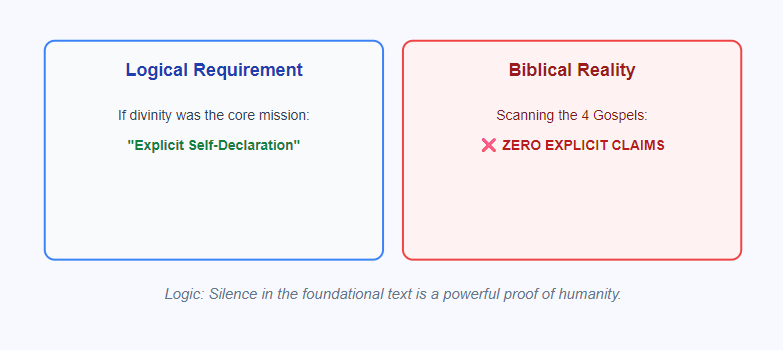
The primary logical pillar in the debate over Is Jesus God in the Bible is the total absence of an explicit self-declaration. In legal and historical forensics, an “explicit claim” is the highest form of evidence. If Jesus intended to change the foundational monotheism of the prophets before him—such as Abraham in the Quran and Bible—he would have logically stated his divinity in clear, unambiguous terms.
Instead, theologians often rely on “inferential claims”—verses that must be interpreted through complex philosophical lenses to suggest divinity. For example, when Jesus says, “I and the Father are one” (John 10:30), the context reveals a unity of purpose and message, not an ontological unity of essence. Logically, if the salvation of humanity depended on believing Jesus is God, the silence of Jesus on this specific phrase is an inexplicable oversight. This silence supports the Authenticity of the Quran which claims that Jesus was a servant who was clear about his status.
2. The Logic of Subordination: “The Father is Greater than I”
A significant challenge to the divinity of Christ is the consistent theme of his subordination to the Creator. In several clear passages, Jesus distinguishes himself from the Father in a way that makes the claim of “Equality in the Trinity” logically impossible.
Jesus stated: “My Father is greater than I” (John 14:28) and “I can of mine own self do nothing” (John 5:30). Logically, if Is Jesus God in the Bible were true, there could be no “greater” or “lesser” within the divine essence. The Islamic perspective affirms the Concept of God in Islam as As-Samad (The Self-Sufficient), upon whom all depend. The dependency of Jesus on the Father for his power, his knowledge, and his very existence is the ultimate logical proof of his Concept of Prophethood rather than his godhead.
3. The Linguistic Context of “Son of God”: Metaphor vs. Reality
A major driver of the Is Jesus God in the Bible inquiry is the title “Son of God.” For the modern Western reader, this title implies biological or ontological divinity. However, in the ancient Hebrew and Semitic context, “Son of God” was a common metaphorical idiom for a righteous person or a prophet.
In the Bible, Adam is called the “Son of God” (Luke 3:38), Solomon is called the “Son of God” (2 Samuel 7:14), and the peacemakers are called “Sons of God” (Matthew 5:9). Logically, if the title “Son of God” makes one divine, then the Bible contains hundreds of gods. Islam provides the logical corrective by restoring the linguistic meaning: Jesus was an honored servant of Allah. The Preservation of the Bible and Quran dialogue reveals how these Semitic metaphors were later “Hellenized” into pagan-like concepts of literal divine offspring.
4. The Command to Worship the Creator Alone
If we ask Is Jesus God in the Bible, we must look at who Jesus directed his followers to worship. In every instance of prayer, Jesus pointed away from himself and toward Allah.
When tempted, Jesus responded: “Worship the Lord your God, and serve him only” (Matthew 4:10). In the Lord’s Prayer, he taught his disciples to pray to “Our Father who art in heaven.” Logically, if Jesus were the object of worship, he would have commanded: “Worship me.” Instead, his life was a testament to Worship in Islam—total submission to the One who is the Lord of all. This consistency is a primary proof for the Sincerity of Prophet Muhammad who reclaimed this pure monotheism.
5. The Ontological Barrier: God Cannot Be a Man
The Is Jesus God in the Bible debate often ignores the logical incompatibility between the attributes of the Creator and the attributes of the creation. Allah is Infinite, Eternal, and Unchanging. A human being is finite, temporal, and subject to biological needs.
Logically, as we explored in Islam and Evolution, the human body is a created biological vessel. To suggest that the Creator became a man who experiences hunger, fatigue, and death is to commit a logical category error. Islam protects the human intellect from this contradiction by asserting that Jesus was a majestic vessel for the Miracles of Jesus in Islam, but his essence remained 100% human. This maintains the Logic of Free Will as a test for those who use their minds.
6. The Evolution of Dogma: From Messenger to Deity
The scholarly investigation into Is Jesus God in the Bible leads to the historical realization that his divinity was a “developed” doctrine. It was not until the Council of Nicaea in 325 CE—centuries after Jesus—that the Church officially declared him “consubstantial” with the Father.
Logically, if the divinity of Jesus were a clear biblical truth, it would not have required centuries of violent debate to finalize. As documented in Britannica’s history of the Council of Nicaea, the decision was heavily influenced by political needs for unity. Islam’s rejection of this council-made theology is a return to the primitive faith of the prophets. This historical shift is a key point in Islam and Secularism studies, showing how dogma can be shaped by social power.
7. The Final Verdict: Divine Integrity
The final and most important reality regarding Is Jesus God in the Bible is the preservation of Divine Integrity. The Quran addresses this exact theological knot with surgical precision, recording a future dialogue where Jesus denies any claim to divinity.
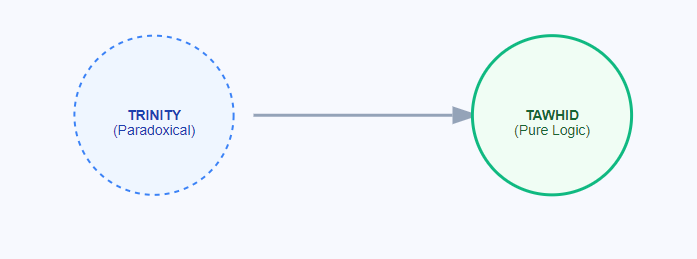
Logically, the Quran provides the only framework that honors the miracles of Jesus while protecting the Tawhid of the Creator. It explains Why Islam is the necessary final chapter: to remove the human additions from the divine path. By answering the question Is Jesus God in the Bible with a definitive “No,” Islam restores the dignity of the Messiah as a mortal human who reached the pinnacle of spiritual excellence.
Conclusion: The Rational Choice
The investigation into Is Jesus God in the Bible leads to a profound rational verdict: the theology of the modern Church is built upon an interpretative framework not supported by the explicit words of Jesus. For the skeptical mind, the silence of the Bible on a direct claim of divinity is a sign to reflect. By recognizing Muhammad in the Bible prophecies, we see that the mission of Jesus was always intended to lead to the finality of Islam. The “Truth Clearly” is that there is no deity worthy of worship except Allah, and Jesus was His humble, honored messenger.














Leave a Reply