

At Truth Clearly, our research team approaches comparative religion with deep respect for all faith traditions. This article provides an academic analysis of historical textual variations, inviting readers to explore scriptural history through an objective and scholarly Islamic perspective.
In the study of sacred texts, the concept of “Inerrancy”—the belief that a book is free from error—is a cornerstone of traditional Christian theology. However, for the skeptical Western reader, the historian, or the student of textual criticism, the presence of Contradictions in the Bible presents a formidable intellectual challenge. From diverging genealogies of Jesus to conflicting accounts of historical events, the internal inconsistencies of the Biblical text raise a fundamental question: Can a book with multiple authors and centuries of human handling be considered the literal, unchanged Word of the Creator?
In the Islamic perspective, specifically within the Sunni tradition, we recognize that Allah sent the Torah and the Gospel as guidance. However, unlike the Authenticity of the Quran, which is the literal and uncreated Speech of Allah preserved without a single letter of change, the previous scriptures were subject to human intervention and “interpretative drift.” The presence of Contradictions in the Bible is not a reason for mockery, but a logical proof that the text has undergone human editing over centuries. This article explores seven profound logical realities regarding these inconsistencies, demonstrating how Islam provides the “Criterion” to distinguish truth from error.
Table of Contents
1. The Logic of Multiple Authorship: Conflicting Perspectives
The primary reason for Contradictions in the Bible is the nature of its authorship. The Bible is a collection of 66 books written by dozens of different authors over nearly 1,500 years. Logically, when multiple human authors write about the same event without a preserved divine standard, variations and contradictions are inevitable.
For example, the two different genealogies of Jesus found in Matthew 1 and Luke 3 provide conflicting lists of ancestors. Logically, a person can only have one biological father and one set of grandparents. Such discrepancies—as analyzed by Britannica’s review of biblical criticism—prove that the records are human historical accounts rather than a direct transcript of Divine Speech. This is a primary reason why Islam and Human Logic find the Quran’s singular authorship so compelling.
2. The Numerical Dilemma: Historical Discrepancies
A recurring theme in the study of Contradictions in the Bible involves numerical inconsistencies in the Old Testament. In the Books of Kings and Chronicles, the same historical events are often described with different numbers.
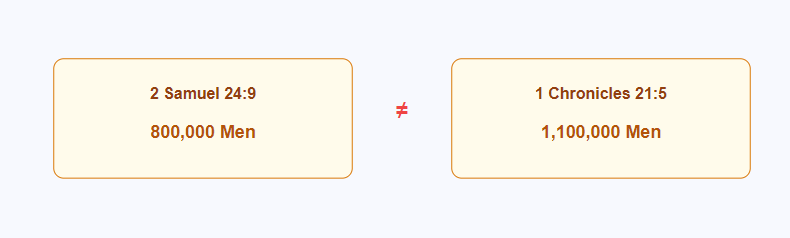
For instance, 2 Samuel 24:9 records 800,000 men of Israel, while 1 Chronicles 21:5 records 1,100,000. Logically, both cannot be correct. While apologists attempt to explain these as “copyist errors,” the very existence of such errors proves that the Preservation of the Bible and Quran followed two different paths. The Bible was subject to the limitations of human scribes, whereas the Quran was divinely protected from the start.
3. The Resurrection Narratives: Contradictory Eye-Witness Accounts?
For the skeptical researcher, the most significant Contradictions in the Bible are found in the accounts of the resurrection. The four Gospels—Matthew, Mark, Luke, and John—differ on crucial details: who went to the tomb, how many angels were there, and to whom Jesus first appeared.
Logically, if these were direct revelations from an All-Knowing Creator, the accounts would be unified. The variations suggest that these are biographical memories written decades after the events, prone to the typical inaccuracies of human testimony. Islam clarifies this confusion by asserting the reality of the Miracles of Jesus in Islam, but correcting the narrative regarding his end, as he was raised by Allah and not crucified, fulfilling the Logic of Suffering.
4. The Logic of Translation Drift: Lost Meanings
A profound reality in the Contradictions in the Bible dialogue is the loss of the original language. Jesus spoke Aramaic, yet the earliest complete manuscripts of the New Testament are in Greek. Every step of translation introduces “Linguistic Drift.”
Logically, a translation is an interpretation. When Semitic concepts are forced into Greek philosophical structures, the original nuance is lost, leading to theological contradictions within the text. This is why the Authenticity of the Quran relies on the preservation of its original Arabic tongue. The Quran acts as a linguistic “Guardian,” protecting the Concept of God in Islam from the ambiguities found in translated scriptures.
5. Theological Contradictions: Law vs. Grace
The Bible contains internal contradictions regarding the very nature of salvation. While Jesus in the Gospels emphasizes the keeping of the Law and personal effort—as seen in Salvation in Islam vs. Christianity—the letters of Paul often suggest that the Law is a “curse” and that faith alone is sufficient.
Logically, these are two different religious systems. This “Theological Contradiction” is the root of Paul vs. Jesus debate. Islam resolves this by siding with the original mission of Jesus, who came to confirm and fulfill the Law, providing a consistent path of Worship in Islam that integrates faith and works.
6. The Problem of Inerrancy and Human Handling
The scholarly investigation into Contradictions in the Bible leads to the realization that the modern concept of “Biblical Inerrancy” is a relatively late development. Many early Church fathers recognized that the text contained human elements and variations.
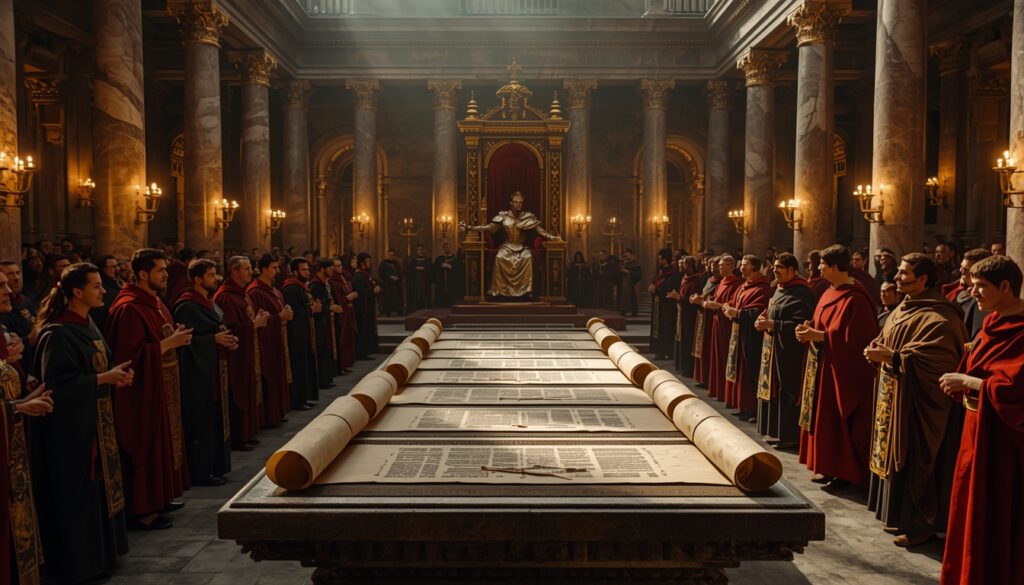
Logically, if a book has been edited by councils—like the Council of Nicaea—it loses its claim to be a direct, unmediated divine message. As explored in Islam and Secularism, the history of the Bible is a history of human interaction with the divine word. The Quran, being uncreated Speech, bypasses this human filtration, serving as the only stable anchor for the Purpose of Life.
7. The Quran as the “Furqan” (The Criterion)
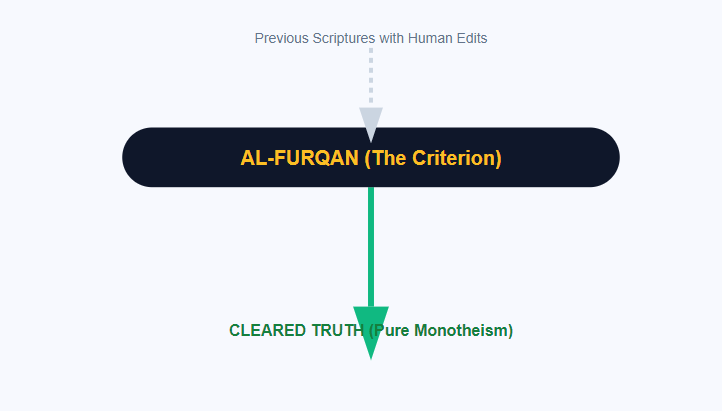
The final reality of Contradictions in the Bible is the logical necessity of a final “Criterion.” If the previous books have been subject to change, the Creator would logically send a final message to clarify the truth.
The Quran fulfills this role as the Muhaimin (Guardian/Witness). It confirms the Prophecies of Muhammad in the Bible while exposing the human additions. By providing a logically consistent and historically preserved text, Islam invites humanity to see the Why Islam answer: it is the only way to return to the pure, uncontradicted truth of the One True God.
Conclusion: Reclaiming Absolute Truth
The study of Contradictions in the Bible is not an attack on faith, but a rational inquiry into the nature of preservation. It proves that human hands, however sincere, cannot replicate the protection afforded to the Divine Speech. By recognizing the limitations of the Bible, the seeker is led toward the Authenticity of the Quran as the final, uncontradicted guide for mankind. The “Truth Clearly” is that while man can edit ink on paper, the Knowledge of Allah remains High above all human intervention.










Leave a Reply