

This research paper is part of Truth Clearly’s commitment to providing an authentic Islamic perspective on theology and history. We adhere to rigorous academic standards, relying exclusively on the Quran, authentic Prophetic traditions, and verified historical sources to provide clarity for the rational seeker.
The existence of a Creator—who is High above His Throne and distinct from His creation—leads to a secondary logical inquiry: How does this Creator communicate His purpose to humanity? For the skeptical observer or the student of philosophy, the Concept of Prophethood often raises questions: “If God wanted to guide us, why not send angels? Or why not simply speak to every person individually?” These inquiries are not new; they were addressed centuries ago within the Islamic framework, which presents prophethood as the most rational method of divine-human interaction.
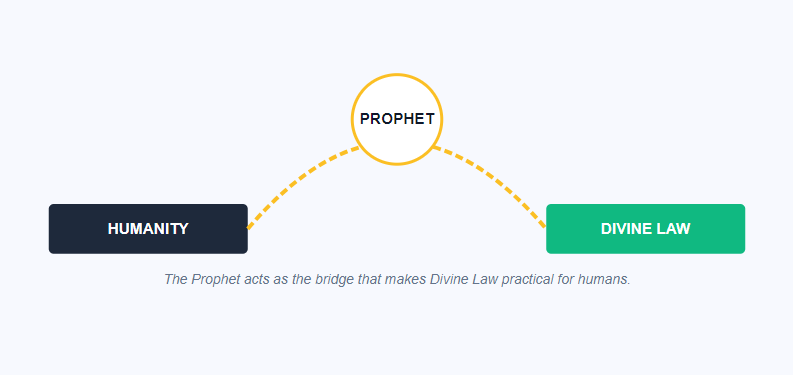
In the Sunni Athari worldview, we understand that Allah is the Most Wise (Al-Hakim) and the Most Merciful (Al-Rahim). He did not create humanity and leave them in a state of existential confusion. Instead, He chose specific human beings to convey His literal and uncreated Speech. The Concept of Prophethood is the bridge between the Infinite Wisdom of the Creator and the finite understanding of the creature. This article explores five profound logical reasons why God communicates through men, demonstrating that prophethood is a necessity for a coherent and just existence.
Table of Contents
1. The Necessity of a Practical Exemplar
The primary logical argument for the Concept of Prophethood being centered on human beings is the need for an “Exemplar.” If God had sent an angel to guide humanity, the skeptical mind would have a perfect excuse for failure: “I cannot follow this law because I am not an angel; I have physical needs and emotions that an angel does not possess.”
By choosing a human being, Allah removes this excuse. A human prophet experiences hunger, fear, joy, and loss. He marries, trades, and navigates the complexities of social life. When such a man follows the Divine Law perfectly, it proves that the Law is “practicable.” Logically, guidance is only meaningful when it can be modeled in a real-world environment. The Sincerity of Prophet Muhammad is evidenced by his life as a father, a leader, and a citizen, providing a blueprint that no celestial being could ever replicate.
2. The Limitation of Human Reason (The Need for Revelation)
While we advocate for Islam and Human Logic, we must logically acknowledge the limits of the human mind. Reason can tell us that a Creator exists, but it cannot tell us what that Creator wants from us. Reason is like an eye; it is a powerful tool, but it cannot see anything in total darkness. Revelation is the “Light” that allows the eye of reason to function.
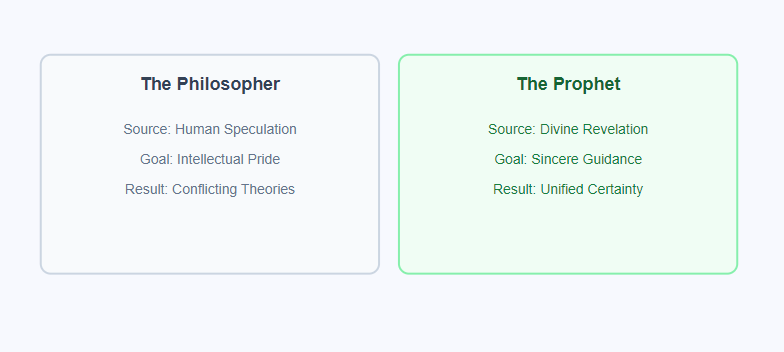
The Concept of Prophethood satisfies this logical gap. Just as a complex machine requires a manual from its designer, the human being requires guidance from the One who created the Origins of the Universe. Without a prophet to convey the specific attributes and commands of Allah, humanity would be left to guess about the Life After Death, leading to a chaos of conflicting moralities. A prophet provides a “Standardized Truth” that unites the human intellect.
3. Miracles as Logical Credentials
A frequent skeptical question regarding the Concept of Prophethood is: “How do we know who is a true prophet and who is a fraud?” The Islamic response is the logic of the Mu’jizah (Miracle). A miracle is a suspension of natural laws by the permission of Allah, acting as a “Divine Signature” on the prophet’s message.
Logically, if God created the laws of nature—as discussed in the Quran and Modern Science—He has the authority to suspend them to validate His messenger. Just as a royal seal validates a letter from a king, the miracles given to Jesus in Islam and the linguistic miracle of the Quran given to Muhammad serve as credentials. This ensures that the acceptance of a prophet is based on objective evidence rather than emotional whim, satisfying the rational demand for proof.
4. The Distinction Between Prophethood and Genius
Critics often attempt to explain the Concept of Prophethood as merely “human genius” or “poetic inspiration.” However, a logical analysis reveals a clear distinction. A genius (like Einstein or Plato) produces work that is a refinement of existing human knowledge. A prophet produces a message that is fundamentally “Other”—it contains information about the unseen, the future, and the Divine that no human effort could produce.
Furthermore, a genius usually seeks fame or intellectual dominance. A prophet, as seen in the Prophecies of Muhammad in the Bible, often faces extreme persecution and offers a message that challenges his own social interests. The logical consistency of the prophetic message across different centuries and cultures points toward a single, transcendent Source rather than various independent human geniuses.
5. Universal Justice and Collective Accountability
Finally, the Concept of Prophethood is a requirement of Divine Justice (‘Adl). Logically, it would be unjust for a Creator to punish a creation for failing a test if the creation was never told the rules of the test. The Quran states: “And never would We punish until We sent a messenger” (Quran 17:15).
By sending prophets to every nation throughout history, Allah ensures that the “argument” of humanity is removed. Every soul has been given a fair opportunity to recognize the Truth. This established the framework for Islam and Human Rights, where every individual is treated as a moral agent with access to divine guidance. Prophethood ensures that the 5 Pillars of Islamic Faith are known and can be acted upon, providing a pathway to success in both worlds.
Conclusion: The Rationality of Divine Communication
The Concept of Prophethood is not a primitive myth; it is a sophisticated logical necessity. It provides a practical model for living, an anchor for morality, and a verified link to the Creator who is High above His Throne. By choosing human messengers, Allah honored the human species and provided the most effective means of guidance.
For the skeptical mind, the consistency of the prophetic chain is a profound sign. It invites us to recognize that we are not alone in a random universe, but are part of a grand narrative of communication. Understanding prophethood allows us to see the Authenticity of the Quran not just as a book, but as the final chapter of a unified divine effort to bring “Truth Clearly” to all of mankind.















Leave a Reply