
In the study of comparative religion and history, few texts possess the imposing stature of the Quran. For the global Muslim community, it is the verbatim word of the Creator. However, for the skeptical Western reader, the agnostic academic, or the student of history, such a claim is not one to be accepted blindly. It demands rigorous scrutiny.
The central question is unavoidable: Is it possible for a man in the 7th-century Arabian desert—who could neither read nor write—to author a book that challenges the foundations of history, embryology, cosmology, and linguistics? Or does the text itself contain evidence of a non-human origin?
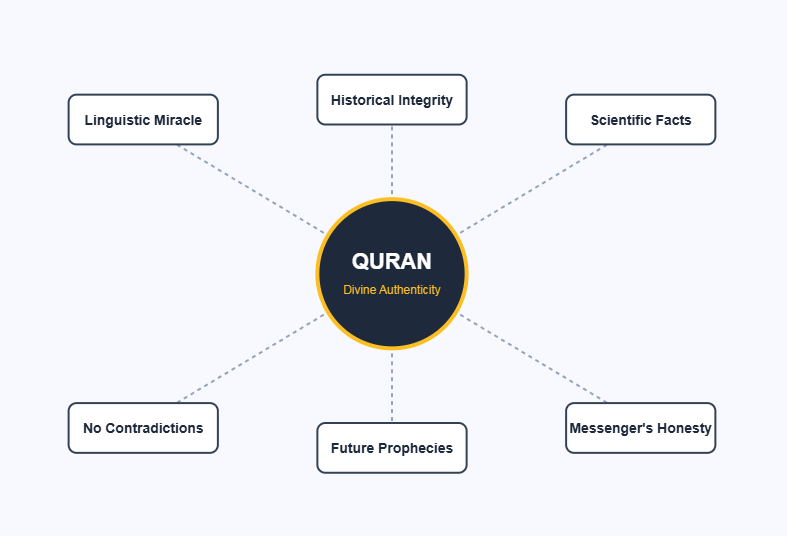
This article does not ask for blind faith. Instead, it invites you to examine the Authenticity of the Quran through the lenses of logic, historical criticism, and modern science. By analyzing the “internal” and “external” evidence, we can construct a rational case that challenges the secular narrative of the book’s authorship.
Table of Contents
1. The Linguistic Miracle: The Unmet Challenge
To understand the argument for the Authenticity of the Quran, one must first understand the environment in which it was revealed. Pre-Islamic Arabia was a society obsessed with language. Poetry was not merely a hobby; it was their media, their political tool, their history, and their highest form of art. Poets were the rock stars of the era, capable of starting wars or forging peace with a single stanza.
Into this environment came Muhammad (peace be upon him), a man known for his integrity but never for poetic ability. Yet, the verses he recited stunned the experts of his time. The Quran exhibited a unique literary structure that followed none of the known sixteen meters of Arabic poetry (Buhur), nor did it resemble the rhymed prose of soothsayers (Saj'). It was a genre entirely of its own.
The Standing Challenge (The Tahaddi)
The Quran boldly challenged its critics—both then and now—to disprove the Authenticity of the Quran by producing something similar. This challenge came in three stages:
- Produce a whole Quran: “Say, ‘If mankind and the jinn gathered in order to produce the like of this Qur’an, they could not produce the like of it…” (Quran 17:88).
- Produce ten chapters: “Or do they say, ‘He invented it’? Say, ‘Then bring ten surahs like it…” (Quran 11:13).
- Produce a single chapter: “And if you are in doubt about what We have sent down upon Our Servant… then produce a surah the like thereof…” (Quran 2:23).
The shortest chapter in the Quran consists of only three lines. Yet, for 1,400 years, despite the violent opposition to Islam and the abundance of Arabic linguistic masters, this challenge remains unmet. For a logical observer, the inability of human experts to replicate the text’s structure serves as primary evidence for the Authenticity of the Quran.
2. Historical Preservation: The Birmingham Manuscript & Oral Tradition
A common skepticism regarding ancient texts (like the Bible or the Torah) involves the “Telephone Game” effect—the idea that oral transmission over centuries leads to inevitable corruption, editing, and loss of the original message. The Authenticity of the Quran stands unique against this critique due to two concurrent methods of preservation: textual and oral.
The Physical Evidence
In 2015, the University of Birmingham made a startling discovery. Radiocarbon dating of a Quranic manuscript held in their library placed it between 568 and 645 CE. This range overlaps with the lifetime of the Prophet Muhammad himself or the years immediately following his death.
“The radiocarbon dating has delivered a result which is exciting and contributes significantly to our understanding of the earliest written copies of the Quran.” — University of Birmingham News.
This physical evidence confirms that the Quran we read today is the same text that existed at the dawn of Islam, supporting the claim of the Authenticity of the Quran.
The Phenomenon of Tawatur (Mass Transmission)
While manuscripts are important, the primary method of preservation was memory. The Quran was not preserved by a small, secretive group of scribes. It was memorized by thousands of people simultaneously (Huffaz).
If a person recites a verse incorrectly in a mosque in Morocco today, a child in Indonesia can correct him. This system of Tawatur (mass transmission) creates a statistical impossibility of collusion. You cannot get thousands of people, across different tribes and later different continents, to agree on a specific lie or alteration without leaving historical traces of the conflict. The text has remained uniform, letter for letter, acting as a safeguard for the Authenticity of the Quran.
3. The Scientific Phenomenon: Knowledge Beyond the 7th Century
One of the most compelling arguments for the modern skeptical mind is the presence of scientific accuracy in the Quran. How could a 7th-century text contain specific details about the natural world that were impossible to verify without modern technology?
It is important to note that the Quran is not a “science textbook,” but a book of signs. However, when it touches upon natural phenomena, it is astoundingly accurate, reinforcing the Authenticity of the Quran.
Cosmology: The Expanding Universe
For centuries, the prevailing scientific view was that the universe was static and eternal. It wasn’t until 1929 that astronomer Edwin Hubble, observing the “redshift” of distant galaxies, proved that the universe is actually expanding.
Astonishingly, the Quran mentioned this 1,400 years ago:
“And the heaven We constructed with strength, and indeed, We are [its] expander.” (Quran 51:47).
The Arabic word used is Musi’un, which literally means “expanding it” or “making it vast.” How did a desert dweller know about galactic physics?
Embryology: The Accurate Stages of Life
The Quran describes the development of the human fetus with precise terminology that aligns with modern microscopy. It describes the stage of Alaqah (a leech-like, suspended substance) and Mudghah (a chewed-like substance).
Dr. Keith Moore, a renowned Professor Emeritus of Anatomy and Embryology at the University of Toronto, was presented with these verses. After examining them, he stated:
“It is clear to me that these statements must have come to Muhammad from God… because almost all of this knowledge was not discovered until many centuries later.”
This alignment between ancient revelation and modern biological discovery serves as a powerful pillar for the Authenticity of the Quran.

4. Historical Precision: The Mystery of Pharaoh’s Body
The Quranic narrative often parallels Biblical stories, but with critical nuances that point to a corrective historical accuracy. A prime example is the story of Moses and the Pharaoh of the Exodus (believed by many scholars to be Ramesses II or Merneptah).
The Bible states that Pharaoh and his army were drowned in the sea (Exodus 14:28), implying total destruction. The Quran confirms the drowning but adds a specific, unique detail regarding Pharaoh’s body:
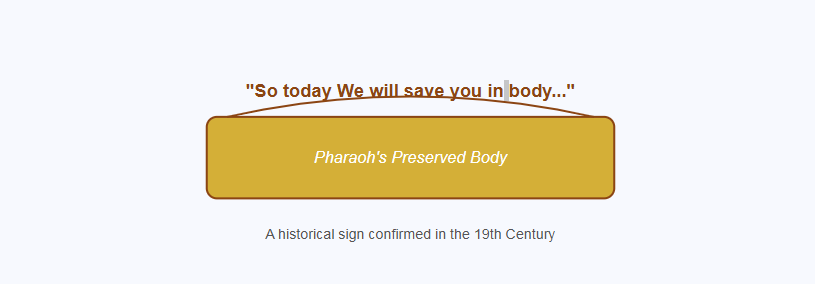
“So today We will save you in body that you may be to those who succeed you a sign…” (Quran 10:92).
For centuries, this verse seemed to contradict the assumption that Pharaoh was lost at sea. However, in the late 19th century, the mummified body of Ramesses II and Merneptah were discovered. In the 1970s, French scientist Dr. Maurice Bucaille examined the mummy of Merneptah and found traces of salt, suggesting he had indeed drowned but his body was recovered and mummified.
The Quran is the only religious text that explicitly predicts the preservation of Pharaoh’s body as a sign for future generations. This precise historical knowledge, unavailable to anyone in the 7th century, strongly supports the Authenticity of the Quran.
5. The Absence of Contradictions over 23 Years
Any writer knows that human thought evolves. A book written by an author over 23 years would inevitably contain contradictions, changes in style, or shifts in perspective—especially if that author went from being a persecuted outcast to a head of state, as Muhammad did.
Yet, the Quran, revealed piecemeal over 23 years, maintains a unified message and structure. It challenges the reader to find errors:
“Then do they not reflect upon the Qur’an? If it had been from [any] other than Allah, they would have found within it much contradiction.” (Quran 4:82).
This internal consistency is logically difficult to explain if the authorship were human. It suggests a single, omniscient source, further validating the Authenticity of the Quran.
6. The Psychological Integrity of the Messenger
Finally, in analyzing the Authenticity of the Quran, we must profile the messenger. If Muhammad (peace be upon him) authored the Quran to gain power or prestige, the content of the book would reflect that. He would likely edit out his mistakes or present himself as a divine being (as happened with the deification of figures like Jesus in some Christian traditions).
However, the Quran does the opposite. It repeatedly reminds Muhammad that he is “only a man” and a “warner.” There are instances where the Quran openly admonishes him.
- The Incident of the Blind Man: Surah ‘Abasa’ (He Frowned) was revealed to reprimand the Prophet for turning away from a blind man (Ibn Umm Maktum) while trying to preach to tribal leaders.
- The Logic: If a man writes a fake autobiography to impress people, he does not include chapters that highlight his own errors in judgment.
The inclusion of these verses serves as a psychological proof of honesty. He was faithfully transmitting a message, even when that message was a critique of his own actions. This intellectual honesty compels the skeptical mind to reconsider the source of the text.
7. Conclusion: The Logical Verdict
When we assemble these pieces of evidence, a clear picture emerges. We are faced with a book that:
- Defies linguistic replication by experts.
- Is historically preserved in both memory and carbon-dated manuscripts.
- Contains scientific facts about the universe and human life unknown in the 7th century.
- Corrects historical narratives with details discovered only recently (Pharaoh’s body).
- Maintains total internal consistency despite being revealed over two turbulent decades.
For the rational seeker, dismissing the Authenticity of the Quran as mere coincidence becomes mathematically and logically harder than accepting its divine claim. It invites humanity not to suspend their intellect, but to use it.
Just as the Five Pillars of Faith provide a logical structure for spiritual life, the Quran provides the logical foundation for belief itself. It stands as an open invitation to read, reflect, and verify.
Leave a Reply