

This research paper is part of Truth Clearly’s commitment to providing an authentic Islamic perspective on theology and history. We adhere to rigorous academic standards, relying exclusively on the Quran, authentic Prophetic traditions, and verified historical sources to provide clarity for the rational seeker.
In the tapestry of human history and theological development, no figure looms larger than Abraham (Ibrahim, peace be upon him). Known as the “Father of the Prophets,” he serves as the primary bridge between the three great monotheistic traditions. For the skeptical Western seeker, the historian, or the student of ancient texts, exploring Abraham in the Quran and Bible is not merely an exercise in comparative mythology; it is a journey into the very origins of rational monotheism. While both scriptures revere him, the Quranic narrative offers a distinct, logically rigorous portrayal of Abraham as a thinker who used reason to dismantle the superstitions of his age.
In the Sunni Athari worldview, we recognize that Abraham was a “Hanif”—one who turned away from all falsehood toward the pure worship of Allah. Allah, the Most High, who is established over His Throne and is distinct from His creation, chose Abraham as His “Khalil” (Intimate Friend). The story of Abraham in the Quran and Bible provides a blueprint for the Concept of God in Islam, emphasizing that faith must be anchored in rational certainty. This article explores seven profound logical realities that define Abraham’s legacy and his role as the architect of absolute monotheism.
Table of Contents
1. The Logic of Inquiry: Abraham’s Search for the Creator
The primary logical distinction in the study of Abraham in the Quran and Bible is the Quran’s detailed account of Abraham’s intellectual journey. Before he was called to prophethood, the Quran depicts him observing the natural world to find the “First Cause.” He looked at the stars, the moon, and the sun, considering each as a potential deity, only to reject them as they set or vanished.
Logically, Abraham’s argument was based on the principle of “contingency.” He reasoned that anything subject to change, disappearance, or the laws of time cannot be the Eternal Creator. He stated: “I do not love those that set” (Quran 6:76). This early application of Islam and Human Logic proves that Islam views reason as the gateway to faith. Unlike a “blind leap,” Abraham’s monotheism was a deduction: if the creation is moving and changing, there must be an Unmoved Mover who is High above His Heavens. This resonates with the Origins of the Universe logic, where a beginning necessitates a Beginner.

2. Dismantling Idols: The Logic of Non-Response
A central event in the narrative of Abraham in the Quran and Bible is his confrontation with the idolaters of his people. Abraham did not merely preach against idols; he used a logical “reductio ad absurdum” to expose their impotence. He famously destroyed the idols, leaving only the largest one, and told his people to “ask it” if it had done the deed.
The logic was simple yet devastating: if these statues cannot speak, protect themselves, or respond to an inquiry, they cannot be gods. This intellectual challenge forced his people to admit that their gods were powerless. In Islamic theology, this is the foundational proof for Tawhid (Absolute Monotheism). Abraham proved that worshiping the created—whether a statue, a man like Jesus in Islam, or the self—is a logical failure. One must only worship the Creator, who spoke His literal and uncreated Speech to the prophets.
3. The Sacrifice: The Logic of Absolute Submission
Perhaps the most famous shared narrative of Abraham in the Quran and Bible is the command to sacrifice his son. While skeptics often view this as a “cruel test,” a deeper logical analysis reveals it as the ultimate test of “Sincerity.”
In the Islamic tradition, Abraham saw a dream which he recognized as revelation from Allah. His son (identified as Ishmael in the Islamic perspective) willingly submitted to the command. Logically, this event established that the Creator’s command supersedes human emotion and social norms. It was the physical manifestation of the Worship in Islam, where the will of the creature is perfectly aligned with the Wisdom of the Creator. Because Abraham was willing to sacrifice his most beloved “earthly attachment,” he proved his absolute Sincerity, and Allah replaced the son with a ram, establishing that the “Blood Sacrifice” was never the goal—the goal was the “Submission of the Heart.”
4. Ishmael and Isaac: The Two Branches of Prophecy
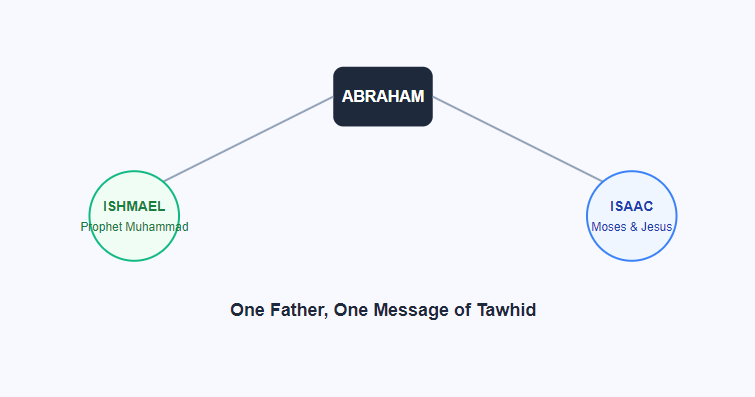
The study of Abraham in the Quran and Bible highlights the lineages that gave birth to the prophetic chain. The Bible focuses heavily on the lineage of Isaac, leading to Moses and Jesus. The Quran, however, restores the balance by highlighting the significance of Ishmael, the firstborn son.
Logically, if Allah promised to bless Abraham and make him a leader of nations, that blessing must encompass both his sons. The Islamic worldview posits that while the Children of Israel received many prophets, the final seal of the prophets—Muhammad—was a fulfillment of the prayer Abraham made while building the Kaaba with Ishmael. This continuity is essential for understanding the Prophecies of Muhammad in the Bible. Abraham stands as the root, while Isaac and Ishmael are the two branches that both carry the message of Objective Morality.
5. The Building of the Kaaba: A Logical Center for Humanity
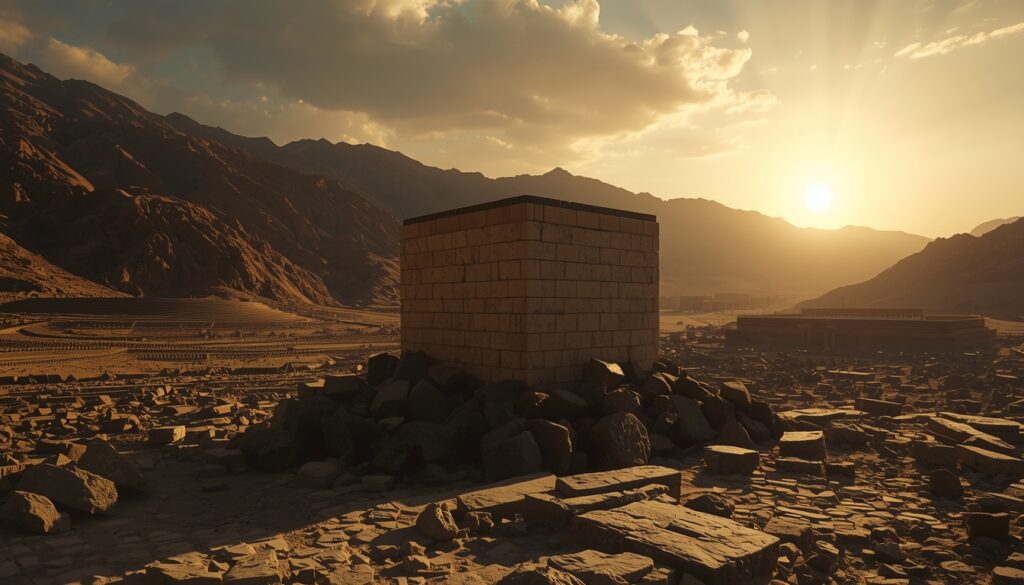
While the Bible mentions Abraham’s travels, the Quran provides a specific logical purpose for his journey to the valley of Mecca: the construction of the Baytullah (House of Allah). Abraham and Ishmael raised the foundations of the Kaaba as a “Sanctuary” and a “Place of Prayer” for all mankind.
Logically, a universal message requires a universal center. The Kaaba serves as the physical anchor for the 5 Pillars of Islamic Faith, providing a unified direction (Qibla) for the world. By establishing this center, Abraham ensured that the worship of the One True God would have a permanent historical and geographical presence. As documented by Britannica’s analysis of the Kaaba, this structure has remained the heart of monotheistic pilgrimage for millennia, fulfilling Abraham’s divine mandate.
6. The Logic of Divine Protection: The Fire of Nimrod
A miraculous reality of Abraham in the Quran and Bible is his survival when cast into a fire by the tyrant Nimrod. The Quran describes Allah’s command: “O fire, be coolness and safety upon Abraham” (Quran 21:69).
For the skeptical mind, this is a “supernatural intervention,” but logically, it is consistent with the Logic of Free Will and Divine Decree. If Allah is the Creator of the “Properties of Fire” (to burn), He has the absolute authority to suspend that property for His servant. This miracle served as a “Logical Signature” to the people of the time, proving that Abraham was supported by the Lord of the Heavens and the Earth. This aligns with the Scientific Miracles we observe today, where the laws of physics are seen as “decrees” rather than “unalterable masters.”
7. Abraham as the Imam (Leader) of Mankind
The final reality of Abraham in the Quran and Bible is his appointment as a leader for all humanity. The Quran states: “Indeed, I will make you a leader (Imam) for the people” (Quran 2:124).
Logically, Abraham was chosen because his life was an exhaustive “case study” in integrity, logic, and sacrifice. He challenged his father, his king, and his society, all while remaining humble and compassionate. This model of Muhammad-like Leadership is what makes Abraham the ultimate prototype for the believer. His life proved that one person, anchored in the truth of Allah, can change the course of human civilization. The Preservation of the Bible and Quran ensures that his story remains a guiding light for every rational seeker.
Conclusion: Reclaiming the Abrahamic Heritage
The scholarly inquiry into Abraham in the Quran and Bible leads to a profound rational verdict: Abraham was the architect of an intellectual revolution. By moving humanity away from the worship of the finite (idols and celestial bodies) toward the worship of the Infinite Creator who is High above His Throne, he established the foundations of a just and logical society.
For the skeptical reader, the Islamic portrayal of Ibrahim offers a bridge between faith and reason. It invites us to recognize that our innate nature (Fitrah) is Abrahamic—it seeks the One, it values the Truth, and it submits to the Wisdom of the Most High. By understanding Abraham’s role in the Authenticity of the Quran, we see that Islam is not a departure from the previous revelations, but their final, logical, and perfected destination. The journey toward “Truth Clearly” is the same journey Abraham took 4,000 years ago: a journey from the darkness of doubt to the brilliant light of Tawhid.








Leave a Reply